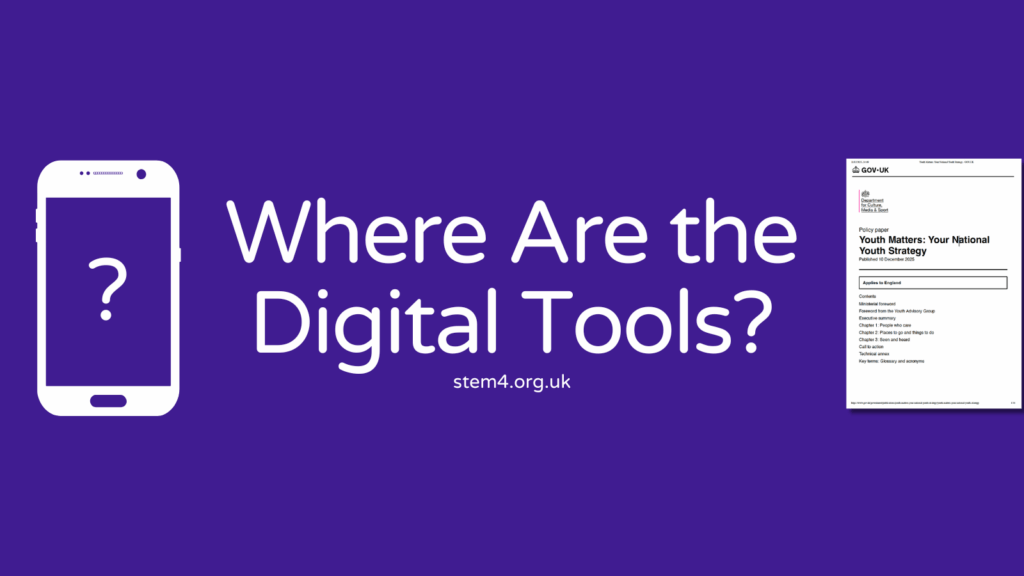
The publication of Youth Matters: Your National Youth Strategy yesterday is a significant and welcome step. It is the first national youth strategy in more than twenty years and offers a long overdue commitment to improving support for a generation facing rising isolation, increasing mental health needs and stretched services. stem4 supports the strategy’s goals of strengthening local provision, investing in Young Futures Hubs and expanding Mental Health Support Teams across schools and colleges by 2029.
However, if the government is serious about addressing the crisis it has outlined, including the lack of safe spaces for young people, the impact of online experiences and the long waits for specialist help, then it must also recognise the essential role of clinically informed digital tools. These tools are already part of how young people manage their mental health every day. Their absence from the strategy creates a significant gap
What the strategy gets right and what it overlooks
The strategy rightly highlights early intervention, local delivery and collaborative approaches. What it does not address is how digital support will be built into these new structures. There is no clear plan for how NHS teams, Young Futures Hubs or schools will adopt clinically validated digital tools, nor any framework for funding, evaluation or training.
Young people do not only seek help during school hours or appointment times. When pathways fail to integrate with real patterns of need, predictable gaps appear. These include the student who receives help at school but goes home to an evening of anxiety, the young person discharged from CAMHS but still in need of safe and structured tools, and the teenager who needs immediate support when urges or panic spike at midnight. Without digital support embedded alongside face to face provision, these very real situations remain unaddressed.
Why digital tools are essential to early intervention
Clinically-informed digital tools bridge the gap between need and access. They are immediate, available at any hour and often the first safe step a young person takes when they feel unable to speak in person.
stem4’s digital portfolio includes:
- Calm Harm, which uses Dialectical Behaviour Therapy to help manage urges to self harm
- Clear Fear, which uses Cognitive Behaviour Therapy to help young people understand and manage anxiety
- Move Mood, which uses the evidence-based treatment Behavioural Activation Therapy to support low mood
- Worth Warrior, uses principles of Cognitive Behaviour Therapy for Eating Disorders to manage negative body image, low self-worth, and related early-stage eating difficulties or disorders
- Combined Minds, designed to help families and friends support a young person in distress using a ‘Strengths-Based’Approach
All our apps are evidence based, clinically developed (by Consultant Clinical Psychologist Dr Nihara Krause MBE ) and co-created with young people. Calm Harm has supported millions, while Clear Fear has peer reviewed evaluations showing reductions in anxiety symptoms and strong acceptability among its users. We are also soon to release a research paper showing the effectiveness of the Worth Warrior app.
Digital support also strengthens school based prevention. stem4’s Clear Fear for Schools programme provides a structured, evidence based approach to teaching anxiety management at a whole school level. It includes student workshops, staff resources and accessible strategies that can be used both in class and independently. This illustrates how digital tools can complement face to face provision and extend support into the times when young people most need it.
Evidence of impact that cannot be ignored
stem4’s digital services provide measurable impact at scale. In the past year, our tools have supported hundreds of thousands of young people, many of whom are not in receipt of any other professional help. Young people report meaningful reductions in symptoms, improved emotional regulation and a reduced need for crisis intervention.
Their voices are clear. They describe Calm Harm and Clear Fear, alongside our other apps, as tools that help them through moments of acute distress, guide them through panic episodes and provide structured strategies when therapy is unavailable. These outcomes are not optional additions. They are essential components of a modern mental health system.
When a national strategy speaks about access to early wellbeing support but does not include digital interventions within its framework or funding plans, it risks overlooking the tools that young people already trust and use.
What the government should do next
For the strategy to meet its ambition, digital support must sit alongside face to face services. We recommend that the government:
1. Fund and adopt evidence based digital tools across all local delivery plans
Local authorities, Mental Health Support Teams and Young Futures Hubs should have dedicated funding to integrate validated digital tools.
2. Establish procurement and evaluation standards
Publicly funded digital tools should meet clear clinical, safety and data protection benchmarks.
3. Embed digital tools within the no wrong front door model
Young people must have access to immediate, effective support outside traditional hours.
4. Train the workforce
Staff in schools, hubs and health services need training to confidently recommend digital tools and integrate them into care plans.
5. Measure digital outcomes nationally
Data collection should include symptom change, safety outcomes and user experience of digital interventions.
Digital support and face to face care must work together
Young people need both in person support and immediate digital help that reflects how they live, communicate and seek assistance. A modern strategy must embrace the tools that young people already trust. Evidence based digital interventions are not an optional extra. They are a fundamental part of early intervention, crisis prevention and long term recovery.
stem4 is ready to work with government, youth services and local systems to create an integrated model that delivers effective, accessible support for all young people.